

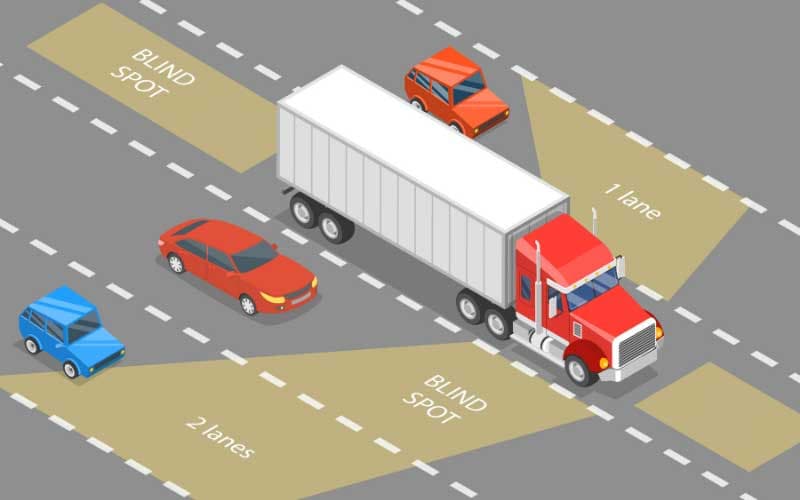
Semi truck blind spots represent a persistent and dangerous reality on Georgia highways, where collisions often occur because drivers of large commercial vehicles cannot see smaller cars in critical areas around their trucks. These blind areas, officially termed 'No-Zones' by the Federal Motor Carrier Safety Administration, can extend for several car lengths along each side of a trailer, reach roughly 20 feet in front of the cab, and stretch almost 200 feet behind the truck. Attorney Charles Graham, known as 'Big Truck Chuck,' emphasizes that when truck drivers say they didn't see another vehicle before a collision, they are often describing a literal physical limitation rather than mere inattention.
The danger of these blind spots is magnified by the substantial weight differential between vehicles. While a typical passenger car weighs approximately 3,000 pounds, a fully loaded semi can reach 80,000 pounds. When such mass moves into space occupied by a smaller vehicle, the smaller vehicle absorbs nearly all the impact force. The right-side blind zone is particularly hazardous, potentially covering two or three full lanes, while the driver's elevated seating position eight to ten feet above the roadway can make compact cars near the front bumper or alongside the trailer completely invisible.
Specific Georgia highway corridors experience heightened risk for blind spot collisions. Interstate 75 through metro Atlanta, Interstate 85 with its complex interchanges near the Perimeter, Interstate 20 through Augusta and Atlanta, and Interstate 285—frequently cited as one of Georgia's most dangerous roads for truck-related collisions—all present conditions where congestion and frequent lane changes increase the likelihood of crashes. These incidents often begin with routine maneuvers like lane changes, merges from short ramps, or wide right turns at busy intersections.
Legal responsibility in blind spot crashes can involve multiple parties, including drivers who fail to execute safe maneuvers, trucking companies that enforce unrealistic schedules or provide inadequate supervision, maintenance providers who neglect mirror systems, and cargo loading companies whose errors affect vehicle handling. Building such cases typically requires examination of driver logs, electronic data from trucks, inspection reports, and training histories. Georgia's modified comparative negligence rule, outlined in O.C.G.A. § 9‑3‑33, bars recovery if an injured person is 50 percent or more at fault and reduces compensation for lower percentages of fault. Insurance carriers sometimes argue that smaller vehicles should not have been in the no-zone, making photographic evidence, electronic data, and witness accounts crucial for establishing facts.
Many individuals involved in these collisions report feeling blamed simply for using public roads. Graham notes that while everyone has a right to use Georgia's highways, trucking companies simultaneously bear a duty to operate safely. More information about semi truck blind spots and accident compensation is available in the article Semi Truck Blind Spots: A Hidden Danger on Georgia Roads. By examining both the mechanical realities of truck no-zones and the legal principles governing subsequent claims, this analysis provides Georgia drivers with a clearer understanding of a significant highway safety issue that affects daily travel across the state's major transportation corridors.